Find Sea Glass, Collect Sea Glass, Beach Hunt!
What to look for in a good beach. Land features, beach layout, the water...

If you have read about sea glass and are anxious to find a good sea
glass beach (perhaps an unknown one), you need to know where to look.
On this page, we discuss where to start in identifying likely places to find sea or beach glass.
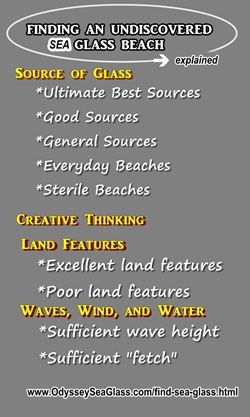
For a beach to be an excellent source of good quality sea glass, you'll need to consider three factors,
These factors are discussed in the following 3-part series on how to discover and finds sea glass beaches of your own:
If you take a look at these factors, you will be able to narrow your search of beaches down to the most probable.
NOTE - There's a lot of information to read here, so please take a moment and bookmark this page - you will probably want to come back to it several times.
Now before we get into the first factor, let's see why these three things - source of glass, land features, waves and water - are important when you want to find a good sea glass beach.
- If there is no source for glass to get onto the beach in the first place, you won't find any.
- Second, a certain type of land contour helps glass get onto the beach, into the waterline, and remain there.
- And thirdly, wave action is highly important in rounding and etching the glass, and to have enough waves, you need to look at what produces the waves.
It's not really complicated. Learning more about these few points will definitely set you ahead of many other beach explorers and treasure hunters.
So, let's get started.
Find Sea Glass
A. SOURCE OF GLASS
Without a good source of glass, a beach will be mediocre at best. Where the glass on a particular beach comes from originally also affects whether it will likely be rare glass or not.
Here we look at four sources for sea glass found on beaches:
And also discuss:
Find Sea Glass
1. Ultimate best sources of sea glass:
The best sources of glass are those where glass was used in various colors, in large quantities, and that were in existence over a long period of time.
The very best sources of this type of glass were glass blowers' or glass makers' shops in years gone by.
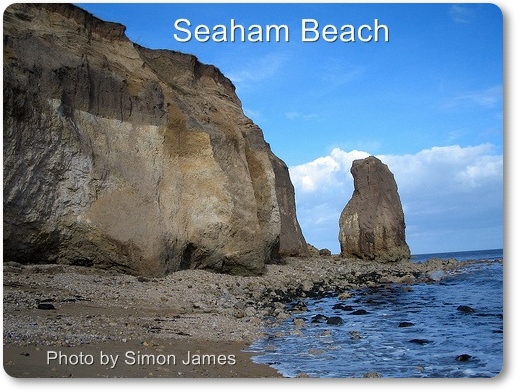
Those that were established close to a beach have produced some notable "glass beaches" in California and Seaham Beach in England. You may be the first to find another!
On the other hand, don't get too excited. Such a source is very uncommon since not many glass manufacturers or glass blowers were located near a beach.
Find Sea Glass
2. Good sources - These are the most likely areas and your best bet to find sea glass:
Garbage Dumps. Yes, old dump sites are hidden treasure sources.
The likelihood of finding some kind of a dump site is quite high, especially in areas that have been populated for many generations.
Of course, when it comes to sea or beach glass, these would be garbage dumps on or near a beach.
On beaches where there were dumps, there's quite a variety of types of glass. This is an important factor to a collector.
Why?
Because included in the stuff dumped out are not only a large variety of bottles, but also other items such as colorful dinnerware, glass lamps, chandeliers, et cetera, that were broken and discarded in the local dump.
Finding a dump site would be your best bet when beginning your search to find sea glass and identify your own seaglass beach.
A good idea is to go to a local historical museum or library to see what you can turn up. Ask old timers or at the nearest town offices.
Naturally, the best dump site would be a whole town site that had been or still is located next to a beach over a period of many decades or centuries.
Think about the area. Try to narrow your initial searches to finding a beach of this type.
A well-known example of this category of beach is Fort Bragg Sea Glass Beach in California.
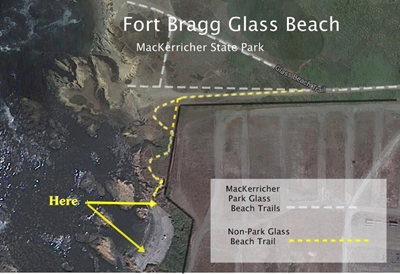
To sum up, aside from the rare glass shop beaches mentioned above, the best beaches to find sea glass are old dump sites (see Land Features below for details about dumps).
Find Sea Glass
3. General sources of good sea glass but at a lower yield:
In this category you can find really good sea glass, but the amount you'll find will be less and the time to find it longer.
But it is still quite rewarding.
These general sources of good sea glass would be sites that were good for
- homesteads,
- camping,
- fishing,
- logging, and/or
- hunting
that overlook a beach. These will produce a fair amount of decent sea glass.
This is true, for example, of Rosario Beach, shown on our video Sea Glass Saunter, which was inhabited by American Indians for many years right up into the 20th century.
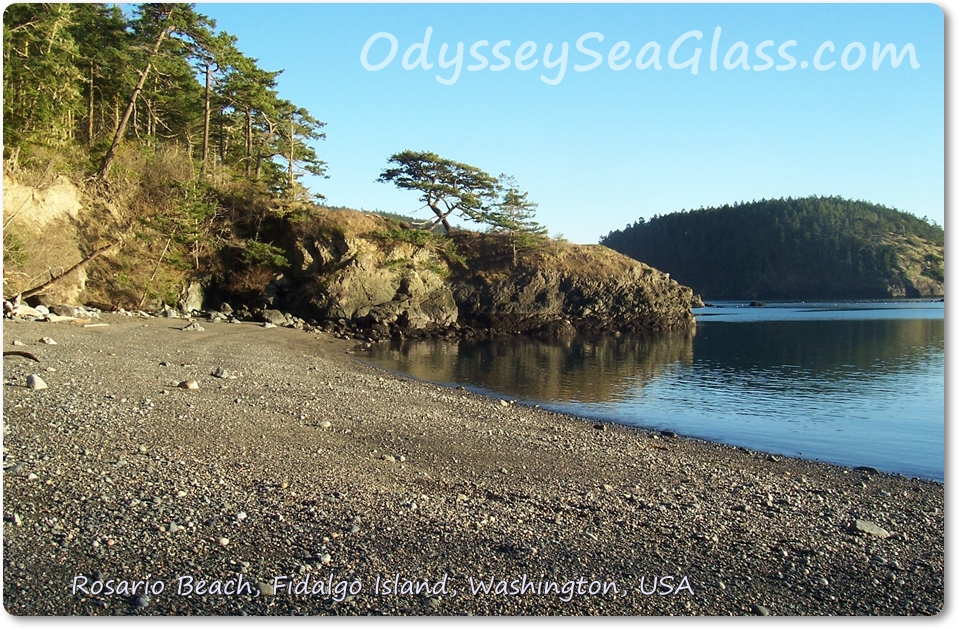
Once again, a local historic library or museum would be a great place to start.
Find Sea Glass
4. Everyday beaches that might have some decent finds:
Among the less valuable sites would be:
Public beaches where folks go to
- picnic,
- swim,
- tip the bottle, or
- just party.
 Sand and Sun Beaches - Great for Parties, Mediocre Sea Glass
The variety and the age of the glass diminishes quite a bit with this type of beach, but you'll still find glass worth keeping if the beach has been popular for at least several decades.
Sterile beaches - nice and clean... unfortunately!
Isolated beaches? Adventure, yes, but not much sea glass!
Although isolated beaches are great places for hiking and enjoying nature, isolated beaches are usually less productive.
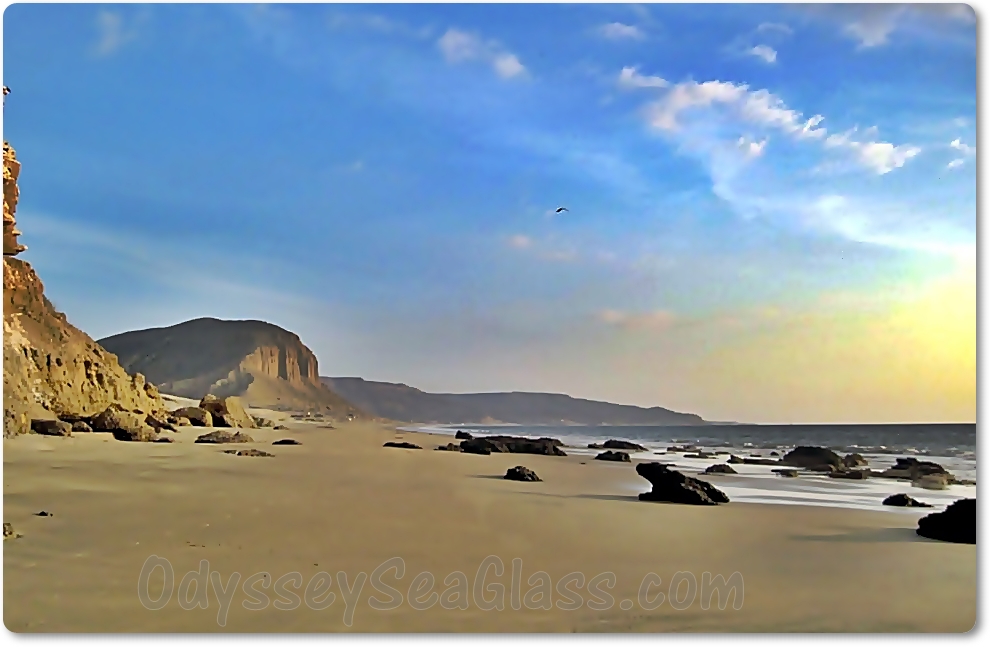
Glass on these beaches might come from hand-blown glass fish floats or bottles floating on ocean currents and finding their way to the beach.
Very rarely do you find much glass on an isolated beach - or other trash.
Of course, the lack of trash and a pristine environment is what makes these beautiful beaches attractive in the first place. But they are not great places for finding sea glass.
Thinking "outside the box"
Use your imagination to find sea glass. Think creatively about what other types of beaches could give good results!
Such as:
1) sites of shipwrecks or
2) beaches that lie along heavily used commercial seaways, such as the entrance to the St. Lawrence River seaway.
In the first case, some shipwreck areas could potentially produce a lot of sea glass.
For example, rum-bottling ports from past centuries and nearby beaches, rum-running islands, and hideout areas may have contained hundreds or thousands of bottles.
In the second case, from beaches along heavily trafficked commercial lanes, glass would come from floating bottles tossed overboard with the garbage.
However, it's highly unlikely that any non-floating glass items dumped overboard would ever find their way to the beach.
Again, for finding these kinds of beaches, a local historical library or museum would be a great place to start your search.
Find Sea Glass
B. LAND FEATURES
Once you have identified a good potential source for the glass, you need to identify certain physical characteristics that make up a good glass beach.
1. Excellent land features
Imagine this scene. A town or highly populated camp has been located on high bluffs, perhaps wooded, overlooking the shore line.
It's not built right on the edge of the cliffs or bluff, but rather is situated 50-500 feet back from the edge of the bluffs.
It's time to take the garbage out. There's no car or trash collection (that's true, children, there once was a time).
How far is hubby or child going to carry the trash? As short a distance as possible...but it has to be out of sight.
Perfect! We're living on the bluffs. Pitch the trash over the bluff. Well, you can't see the shoreline from the cabin, can you? Glass on the beach.
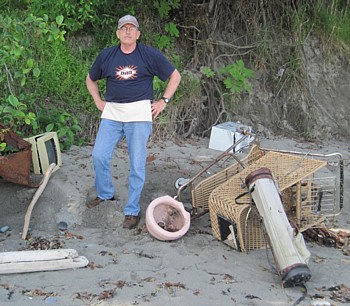
Amazingly, this is still happening as seen above even though most folks have a vehicle and a landfill nearby.
It's good for future "sea glassers," though!

Aside from dumping directly over the bluff, there are other ways for dumped glass to get to the surfline.
Extending back from the cliffs are gullies, a favorite for town dumps even in these modern times.
For a whole town, the garbage might go into one of the deeper gullies, or for a camp, into the smaller gullies or over the cliff. Along comes a torrent and we have glass washed down the gullies onto the beach.
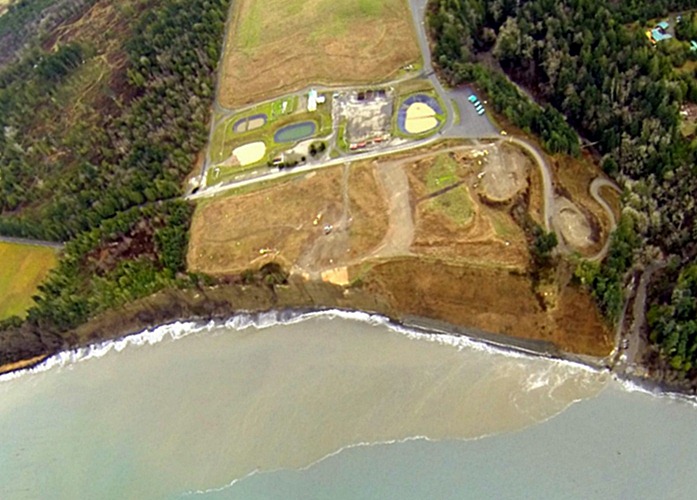 Old Gully Now Landfill - Aerial View
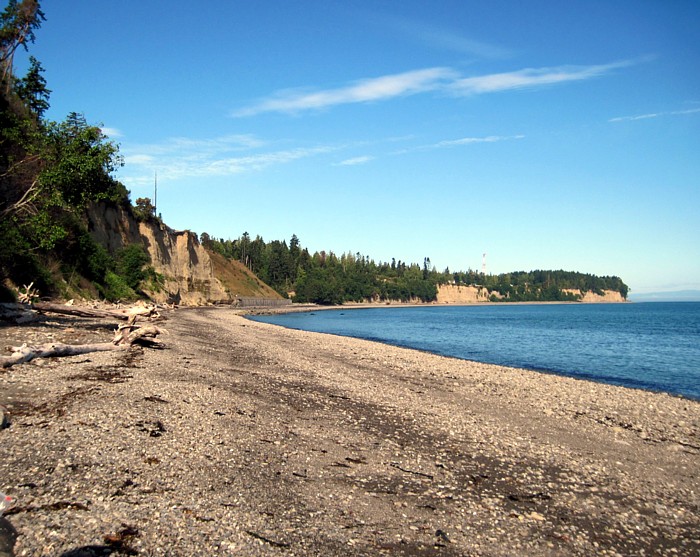 Old Gully Now Landfill - Beach View
Eventually, the rest of the trash (plastic didn't exist back then) decomposes and just the glass and ceramic or pottery shards are left. Bingo!
Even if the trash was dumped or buried in the back yard, it eventually ends up on the beach.
Over the years, the wave action erodes away the cliff, the stuff on top falls down onto the beach, gets tumbled, and there's the glass.
In the photos above, a current landfill is shown that has filled up a gully; the erosion is impossible to control, and the nearby town in Washington is having big problems.
An example of wave erosion can be seen where I lived years ago in Santa Cruz, California.
Over the years, whole blocks of houses and roads have fallen into the surf line on East Cliff Drive.
Although I haven't had the chance to go back and look, I definitely would consider it a very likely place to find sea glass.
2. Poor land features
Land that stretches away fairly flat from the water is an indication that this may not be a good area to find sea glass.
Why? Well, let's say the source of glass was a dump, whether a large dump or one behind somebody's cabin. How would the glass get onto the beach?
Unless it was deliberately carried or hauled (horse and cart) to the beach and thrown onto it, it's very unlikely that there would be any way for the glass to migrate to the waterline.
It would just sit where it was dumped and never make it to the beach. It would be difficult to find sea glass in this area.
 La Boquita Beach - flat, sandy, poor finds
Seen in this small photo of a beach we frequented in Nicaragua.
Low-lying or flat land along a beach is an indication that it just will probably not be that great a beach to find sea glass in terms of quantity and this beach was no exception.
Another drawback to flat land is this:
Streams, marshes, et cetera, in low-lying areas are slow moving, and, because the land is flat, much of the runoff water that gets to the ocean has deposited thick layers of sediment that may be many feet deep along the shoreline.
Glass that would originally be lying on top or near the surface of the beach can be buried many feet deep under the sand.
That's if it even made it to the flat beach in the first place.
For the same reason, those beautiful, long sandy beaches that are so good for walking and enjoying nature may just not be very good for sea glass.
The low land, lots of sand, and lack of the erosion effect that would be found on bluffs and cliffs are factors that tend to bury the glass rather than to uncover it.
Find Sea Glass
C. WAVES and WATER
The body of water where a good beach for glass can be found must have:
Without wave action to tumble the glass, it will never turn into beach glass. It will remain sharp edged and shiny with little change from a fresh shard.
 La Boquita - Plenty of Waves
On the other hand, too much wave action possibly could be bad. A lot of wave action tends to either bury the glass, drag it into deeper water, or scatter it over a larger area.
The exception to this might be rocky coastlines with indentations where the rocks, sand, and glass remain trapped in the coves in spite of continuous rough waves.
Glass under these conditions does develop into highly tumbled sea glass in a relatively short time but may be broken up into smaller pieces than glass found under less rough conditions.
Wave Height
Minimum wave height of 1-2 feet
Wave action that generally is less than about 1 foot high just does not produce sufficient tumbling to make well-rounded frosted seaglass, even if the glass has been on the shore for a long time.
Example: Puget Sound - We have that problem along a portion of the beaches in the Puget Sound area of Washington State, where the San Juan Islands and other islands and peninsulas block the ocean swells.
On the sides that face the large open sea through the Juan de Fuca Strait, the sea glass is great. But on the less-exposed shores, the the glass is poorly tumbled and barely frosted.
Fetch
Minimum fetch of 25 miles
Definition - Fetch: The distance in the direction of the prevailing wind that air or water can travel continuously without obstruction.
Waves are produced by wind blowing over a body of water. If the water is not wide enough, waves will not be high enough.
For example, a lake that is less than 25 miles in any direction will not have enough fetch (unobstructed water) for 1-2 foot waves to build up regularly enough to produce beach glass.
So, you need to take a look at the fetch of the water off a beach to see if there is enough wave action year round to produce tumbled glass.
Again, to produce the minimum 1-2 foot waves that are needed to tumble sea glass, the fetch or stretch of open water that the wind can blow across, usually needs to be a minimum of 25 miles.
In other words, a lake that is less than 25 miles across will not have enough wind distance to produce enough waves to make tumbled glass.
So - Look at a map...or stand on the beach. Can you see any stretch of open water that extends in a straight line for more than 25 miles? If not, the chances are very poor that you'll find sea glass, at least well-tumbled, rounded, nicely-frosted sea glass.
A caveat: There are no hard and fast rules. These are good guidelines as a starting point. There are always exceptions to the above points.
Recent Articles


-
M'diq ville du nord du Maroc northern Morocco
May 20, 25 07:05 AM
 La plage de la ville de M'diq au nord du Maroc il y a du verre de mer. Je le ramasse et je fais des tableaux en verre poli par la mer. There is sea glass
 -
Kalk Bay South Africa Sea Glass
May 13, 25 01:00 PM
 St James, Kalk Bay, Southern Peninsula, South Africa
 -
Sea Glass Identification Help
May 13, 25 12:41 PM
 Hi, just found this piece of seaglass the other day. I initially thought that it was a black pebble but when I held it up to the sunlight I could see a
 -
What might this be? New Brunswick, Canada
May 13, 25 12:40 PM
 Campobello Island Island in New Brunswick, Canada
 -
Burnsco Sea View Glass Wellington New Zealand
May 13, 25 12:35 PM
 The beach near Bursco Sea View, Wellington., New Zealand. Summarised in the attached photos. Not that much sea glass found. A few hours after high tide.
 -
Limanaki Beach
May 13, 25 12:33 PM
 Limanaki Beach near Fira in Santorini, Greece You have to rent a car or rent an ATV to get there. Small beach you can finish walking in 10 minutes but
 -
Unknown
May 13, 25 12:28 PM
 Can you identify this piece for me , please
 -
Travelahawk Beach, Ireland
Sep 06, 24 12:38 PM
 Name of the Beach: Travelahawk Beach City nearest to that beach: Wicklow The state, country, or island where the beach is: Ireland Travelahawk Beach
 -
Aug 10 2024 crescent beach ns
Aug 12, 24 01:36 PM
 I'm curious about this amber sea glass and how it could be dated?
 -
Woody Point, Queensland Sea Glass
Aug 06, 24 08:32 AM
 Discovered a lot of sea glass on the low -incoming high tide at Woody Point! I wasn't sure I would find anything. Even found a piece of old green vitrolite
Comments!
We love receiving your comments, but please read the notes below before posting. Thank you!NOTES:
All comments are moderated. If you leave the page you won't see your comment until it is approved.
Select the "Post to Facebook" check box to be notified on FB when a reply has been posted.
If you scan the previous comments you may find an answer to your question. Click the "View X more" link at the bottom (if visible) to see all comments.
Photos - If you would like to include a photo, please use our Photo Forums.
Questions - If you have a question, it may already be answered. Please tap or click here to search of our site first.