Home - Sea Glass Colors - Black Sea Glass
Black Sea Glass
On this page, you'll find out about:
- What is Black Sea Glass?
- Black Sea Glass - Rare? Is it Hard to Find?
- The Making of Black Glass for Black Glass Merchandise
From what we've researched, heard from others, and found through experience is that true "black" glass is almost impossible to find.
Well, not impossible. Just very hard. We'll talk about why farther down the page.
What Is Black Sea Glass?
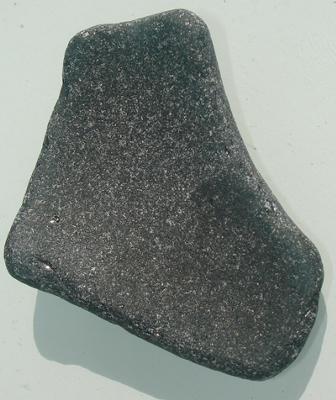
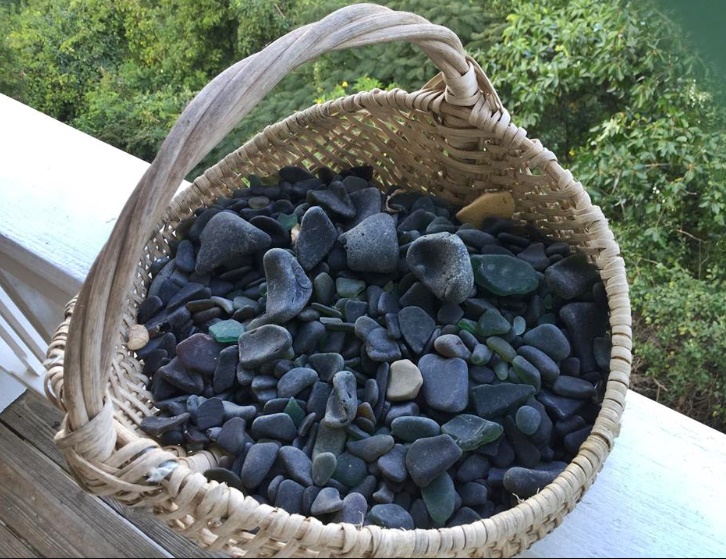
The term "black glass" (also called blackglass), as used frequently by sea glass collectors as well as collectors of bottles, insulators and some other old glass products, often refers to glass that APPEARS to be black.
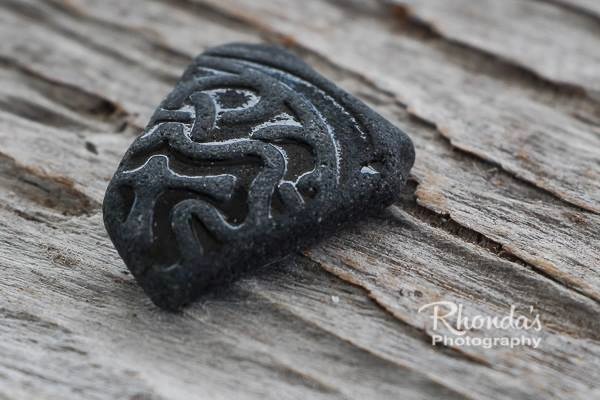
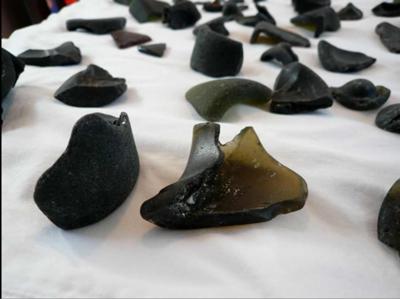
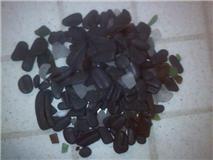
Here's an example of some "black sea glass" from Italy.
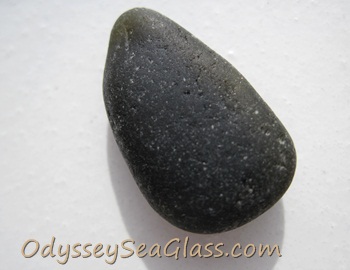
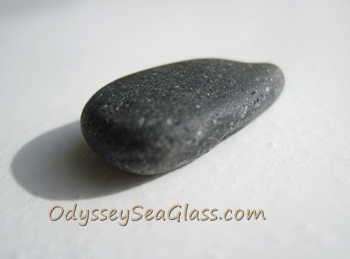
The common name "black glass" is perfectly fine to use when referring to glass that appears to be black to the naked eye.
This very dark glass, though, when held to bright light, shows that it is actually colored.
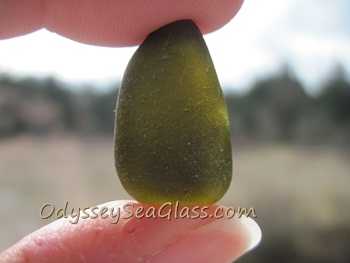
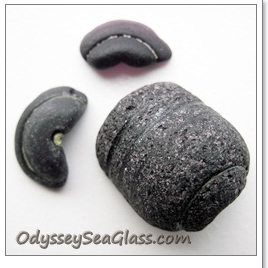
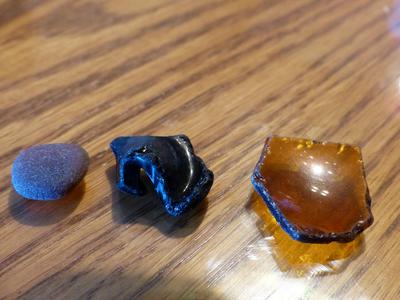
"Black glass" in many cases is a very dark olive green. However, it can also be a very dark shade of purple, red, blue, or brown.
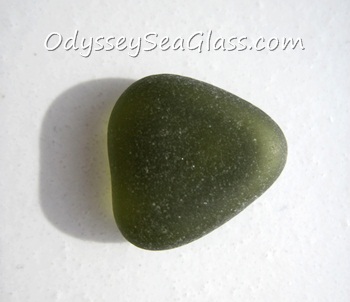
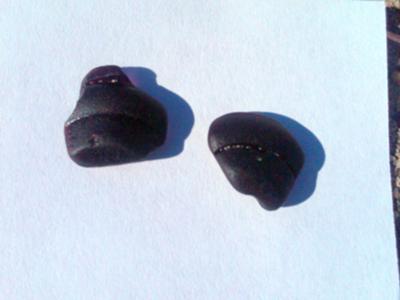
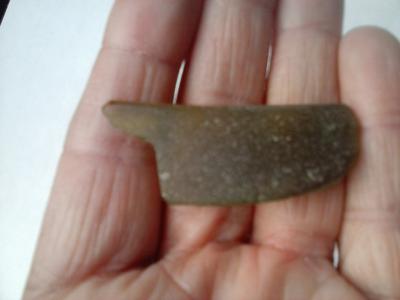
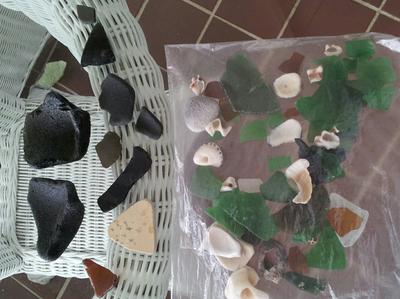
In the next photos, the "black sea glass" is a somewhat lighter shade of green, which can be seen when the sun shines through it.
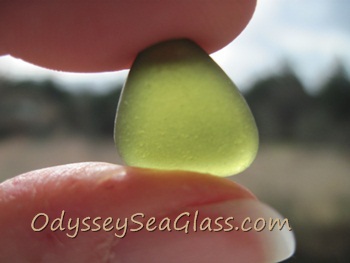
OdysseySeaGlass Ad:
There's nothing like an early morning sea glass hunt - here's our poster with sea glass we found early morning on a Washington hike.
Buy the "Secret of the Sea" - Odyssey Sea Glass Poster by David and Lin
Black Sea Glass - Rare?
"Black glass" of dark green or dark brown has in fairly common use for bottles for many centuries. However, these colors are somewhat rare to find in a sea glass collection. Why?
Well, for one very good reason at least - it's very difficult in normal lighting to tell the difference between a piece of very dark, frosted sea glass and the pebbles or rocks on the beach. Add some seaweed and shells and your eyes are going to have a a lot of fun trying to pick it out.
*** When we have found black glass, it has NOT been because of the color; rather, it, just "looked" like sea glass.
After searching for sea glass on many trips to the beach, your eye begins to catch not only colors and shapes but will start to catch the type of frosted or pitted surface found almost exclusively on sea or beach glass.
So, in spite of being the same color as everything around it, your trained eye may still "fixate" on that object. ***
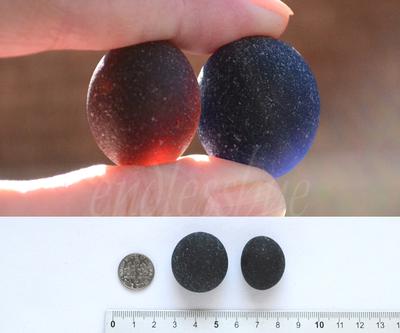
Much of the "black glass," or very dark glass, that ends up as tumbled, frosted sea glass was originally from bottles containing fluids that could be damaged by exposure to sunlight. This was most important one hundred years ago before refrigeration existed and before the "sophisticated" preservatives that are now widely used.
In many cases medicines and chemicals or even beer and wine had to be transported and stored for long periods of time in less than optimum conditions, and dark, thick glass was one of the best ways to insure conservation of the liquid the bottles contained.
(One of the biggest "black" sea glass producers were electrical companies, using a type of black material called vitrite (see more) for insulators.)
Summarizing this information, then, we can say that black beach/sea glass is fairly rare among collectors for at least these two reasons.
- First, it is extremely hard to distinguish a tumbled black glass fragment from the other rocks on the beach, so what little there might be is likely to be overlooked.
- Second, most black glass bottles were made before 1880. Ornamental or dishware black glass products (see below) make up only a tiny portion of production compared to bottles.
More About the Use of Black Glass in Bottles
Strength - Most of the old black glass bottles colors are due to a high concentration of iron oxide, either naturally found in the sand used, or added during glass production.
Some glass was made by adding iron slag, which produced a stronger glass more resistant to shattering; another reason for using black glass for bottles subject to harsh conditions in centuries past.
You might compare the strength of this "fortified" glass to some other glass colors. Colors such as blue, green, brown, and red were generally made by adding metals or combinations of metals. The strength of the glass was affected by how the metal used reacted with the other ingredients in the glass-making process.
*See more about this color at the Society for Historical Archaeology
From what we've seen, the very dark "black" sea glass is more resistant to breakage, and very dark colors (with the added iron slag, etc) result in finds of some pretty hunky old sea glass.
The Making of Black Glass for Black Glass Merchandise
The center for glassmaking from the 14th century was the island of Murano in present-day Italy, where many new techniques were developed.
Murano became the center of a lucrative export trade in dinnerware, mirrors, and other luxury items. Black glass was called obsidianus after obsidian stone.
Milk glass first made in Venice in the 16th century included black glass.
Influenced by the milk glass from Venice, Opaline glass was a decorative style of glass made in France from 1800 to the 1890s and colors included black glass.
Some Depression glass was black. This was dinnerware and related glassware, not bottles. For example, this flower arrangement bowl.
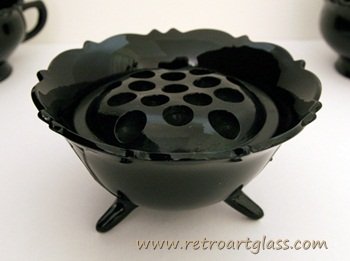 Photo courtesy of www.retroartglass.com Black depression glass flower bowl.
Contemporary Fiesta ware (since 1986) included black glass.
See Warman's Depression Glass: Identification and Value Guide
Other general uses:
Other agents used to produce "black" glass are:
- Chromium, a powerful coloring agent used to produce dark green to black glass, now replacing the iron oxide used previously.
- Sulfur with iron and carbon produces amber glass which can vary from very light straw to a deep reddish-brown or even black.
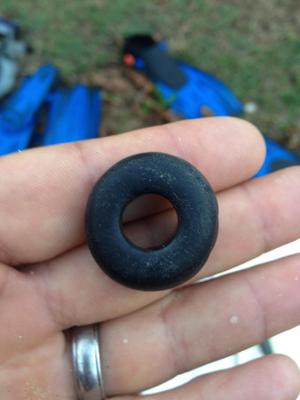
Vitrite, also known as foam glass: A very low fusing point black glass mainly used for the insulation base of electric lamps and produced in large quantities.
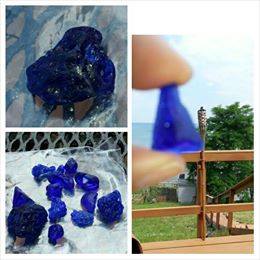
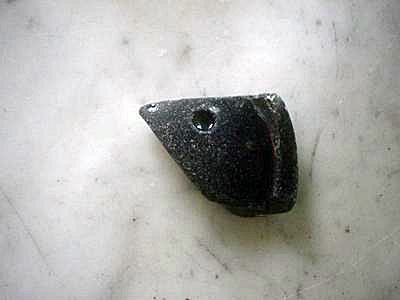
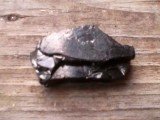
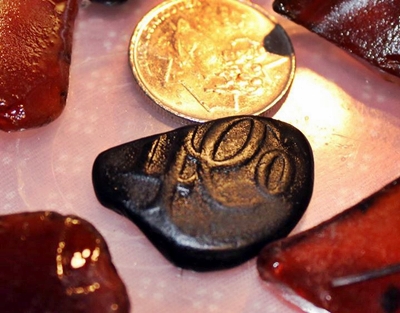
VitriteKelly Johnson, one of our viewers, has done research on vitrite and has kindly add this information: Vitrite is slag glass that was used a dielectric which is an electrical insulator that was used at the base of incandescent light bulbs some 65-75 years ago. If you break a thin piece of this and hold it up to the light you will see dark purple/blue glass, some look black on the ground and is passed up. This glass was made up of ground-up glass along with lead and manganese oxide (the manganese gives it the dark purple color). General Electric produced incandescent light bulbs in Conneaut, Ohio along Lake Erie between 1941 and 2008. (see fig. 10) From 1950 – 1960’s its rumored GE would discard glass and it was used as landfill along the shoreline. Here is black glass from Lake Erie (I did a college paper on Sea/Beach Glass and wouldn't you know it, could not find any of this glass for my presentation this Spring, but 2 weeks we go on vacation and I found some.)
|
More Black Sea Glass:
Photos open slide show / Titles open original page


Recent Articles


-
Grant Park Picnic Area 5 and Seven Bridges Trail in South Milwaukee, WI
Oct 14, 25 10:58 AM
 Grant Park Picnic Area 5 and Seven Bridges Trail in South Milwaukee, WI Put grant park beach picnic area 5 in your map and park at the parking lot at
 -
What could this sea glass from Newport RI be from?
Oct 13, 25 12:57 PM
 I found this in Newport Rhode Island, the writing is very cool and id love to know what it’s from. You’ve unearthed something truly special — a red
 -
From Once the Ocean | Sea Glass Origins & Artistry – Odyssey Sea Glass
Sep 10, 25 02:21 PM
 Thank you, Jai! New Jersey can produce some nice sea glass. Sea glass crafts are such a fun way to turn those little ocean treasures into something beautiful
 -
Need help identifying sea glass
Aug 23, 25 08:37 AM
 Hi, This is the second piece of sea glass I have ever found. Not sure what it might have been. Pattern on it, shape and size has me wondering. Thank you
 -
Seacliff Beach Sea Glass | Santa Cruz Collecting & Cement Ship History
Aug 19, 25 04:09 PM
Explore Seacliff Beach sea glass in Santa Cruz—tips, photos, and the story of the cement ship now mostly washed away by storms. -
Best Sea Glass Beaches in Massachusetts
Aug 15, 25 07:18 PM
 Massachusetts sea glass finds—thick, frosted treasures with mysterious origins and timeless coastal charm.
 -
Responsible Sea Glass Collecting
Aug 14, 25 03:44 PM
 Explore the debate over sea glass collecting and its impact on beaches. Learn tips for responsible beachcombing, why sea glass is disappearing, and how to enjoy this hobby sustainably. Find advice, st…
 -
Conneaut Beach, Ohio - Sea Glass
Aug 08, 25 12:04 PM
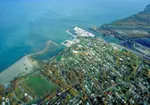 Conneaut Beach, Ohio — Sea Glass Conneaut Beach, tucked along the shores of Lake Erie in northeastern Ohio near Pennsylvania, offers
 -
Santa Monica: Sun, Sand, and Maybe Sea Glass?
Aug 01, 25 04:45 PM
Explore Santa Monica's top attractions and learn about the possibility of finding sea glass. Get tips for beachcombing on this famous California beach and see if you can discover your own ocean-tumble… -
Culburra beach glass
Jul 31, 25 05:17 PM
Culburra Beach – South Coast Sea Glass Haven Nestled on the beautiful South Coast of New South Wales, Culburra Beach is a quiet coastal town known for
Comments!
We love receiving your comments, but please read the notes below before posting. Thank you!NOTES:
All comments are moderated. If you leave the page you won't see your comment until it is approved.
Select the "Post to Facebook" check box to be notified on FB when a reply has been posted.
If you scan the previous comments you may find an answer to your question. Click the "View X more" link at the bottom (if visible) to see all comments.
Photos - If you would like to include a photo, please use our Photo Forums.
Questions - If you have a question, it may already be answered. Please tap or click here to search of our site first.